Education in the Age of the Algorithm
Artificial Intelligence is changing how universities educate students. Now colleges face the challenge of preparing students for an AI-focused world while keeping education human.
Artificial intelligence is a tool that everyone is exposed to, especially our students. Young adults are learning how to use the tool on their own, but don’t fully understand its true potential and downfalls. Now it is up to the schools to guide the students towards the AI-driven future, while finding a way to keep education human.
This project was made in collaboration with Alexandra Tavaglione over the span of one semester. Read the full article below!
Education in the Age of the Algorithm
By: Brenna Medeiros and Alex Tavaglione
BRISTOL, R.I. — Artificial Intelligence is changing how Universities teach their students. They now have to find a balance between the artificial and the human.
AI in the Classrooms
AI has risen in popularity, especially amongst students. In a 2025 survey of more than 1,100 United States students across colleges, over 90 percent said they had “used AI academically, with nearly three-quarters saying their usage increased over the past year.”
Professors now face the obstacle of trying to teach students without the interference of AI. Some professor however, have embraced the change, integrating the software into their classes. The difficulty now becomes maintaining the balance of human thought and AI assistance.
Some professors, like Roger Williams University Professor of Computer Science Sonya Cates, feel that AI is being adopted too quickly.
“With the speed of adoption thats happened, I think everyone’s rushed to use it…That’s not necessarily a bad thing, if it’s done thoughtfully. I’m just afraid it’s not being done thoughtfully in a lot of cases.” ”
Rushed integration of AI can lead to a reliance on the tool that students may not fully understand. Students have to be taught how to critically evaluate the programs. A lack of AI literacy creates opportunities for ethical concerns with the correct usage of the software. Classes in the humanities, for example, teach the skills needed to check AI and ensure it is giving the desired outputs.
Enrollment Data
Students are coming to college aware of the AI tools at their fingertips. Recent enrollment data from Roger Williams University shows that students may be taking that into consideration when picking a major.
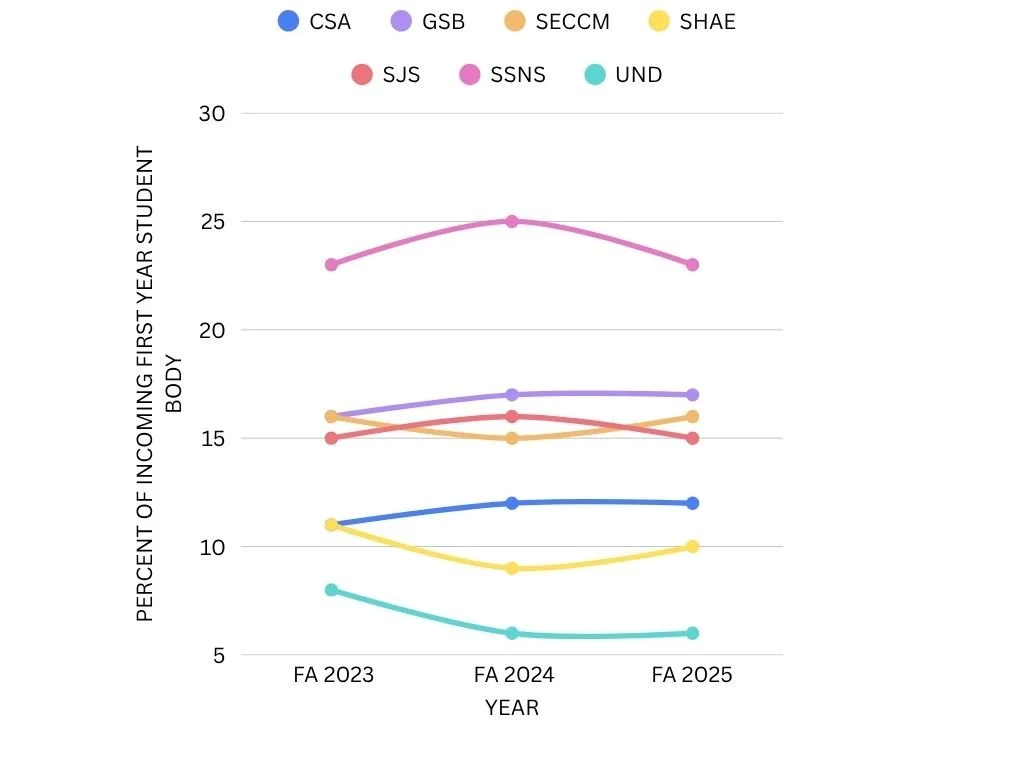
CSA: Cummings School of Architecture; GSB: Gabelli School of Business; SECCM: School of Engineering, Computing, and Construction Management; SHAE: School of Humanities, Arts, and Education; SJS: School of Justice Studies; SSNS: School of Social and Natural Sciences; UND: Undecided
More students are turning towards science and business-focused degrees, while the humanities have the lowest number of declared students. According to Business Insider, one in six students says they’ve changed their major due to AI’s impact on the job market.
Effect on students
The integration of AI into both the workforce and the college classroom draws concern for some students, leaving them worried about their future careers. In a 2025 survey, 55 percent of students believed AI would do more to limit their job opportunities than grow them.
Roger Williams University students, however, voiced an opposing sentiment. Gabrielle Iocca, a Sophomore Architecture student, explained that AI isn’t a part of her classes. Looking towards her future career, she isn’t worried about AI taking her job, nor does she think it will impact her the most.
As the world becomes more AI-driven, the next generation is divided on the software’s impact on the workforce. Some worry that the tech is taking jobs, while others pay it no mind. No matter the perspective, the goal for students is to keep their jobs human while using AI tools that can aid them.
Turning towards the Humanities
Human skills such as critical thinking and empathy, AI cannot replace. The necessity for human influence on AI shows that fields such as the humanities are necessary in an AI-focused world.
The humanities teach skills that are the foundation for understanding AI ethically. For example, critical thinking skills allow students to question the content AI is generating. The ability to think about what we see and question it is something AI simply cannot do. Teaching students to understand the tools they use prepares them for the AI-focused world they are coming into, while ensuring they understand the critical skills needed from the humanities.