Bot vs Brain
Bots vs. Brain highlights the growing tension between humans and artificial intelligence agents, applications, and tools. We interview expert sources to explore the intersection of human connections and agentic AI, alongside the growing need for AI literacy.
AI literacy is a growing concern in our society, where artificial intelligence software is becoming significantly more common. Through talking to multiple experts and seeing real-world examples of AI in action, it is clear that the age of AI is upon us. As a society, we need to understand the tools that we use on a daily basis.
This project was made in collaboration with Alexandra Tavaglione and was created over the span of a full academic year. Read the full article below!
Critical Thinking in the Age of the Algorithm
By: Brenna Medeiros and Alex Tavaglione
BRISTOL, R.I. — As artificial intelligence becomes more important in society, the knowledge of how to use it is a must-learn skill.
What is AI Literacy?
Artificial intelligence is technology that imitates aspects of human skills and thinking. This tool is easily accessible and, at first glance, easy to use. As AI becomes more widespread, it is critical to learn the necessary skills and knowledge to navigate the emerging technology.
AI literacy is the knowledge and skills that enable humans to critically understand, evaluate, and use AI systems and tools to safely and ethically participate in an increasingly digital world.
Being AI literate helps people teach the skills that are needed to fully understand how to use AI ethically. These critical thinking skills are crucial, as they are not something AI can replace.
Impact of AI on jobs
As AI is integrated more into our lives, and specifically our jobs, the workforce is now directly affected by this growing technology. As shown in the graph below, the employment rates rose in the United States before ChatGPT was released. After the release, employment rates dropped for the computer systems industry, alongside jobs with high exposure to AI.
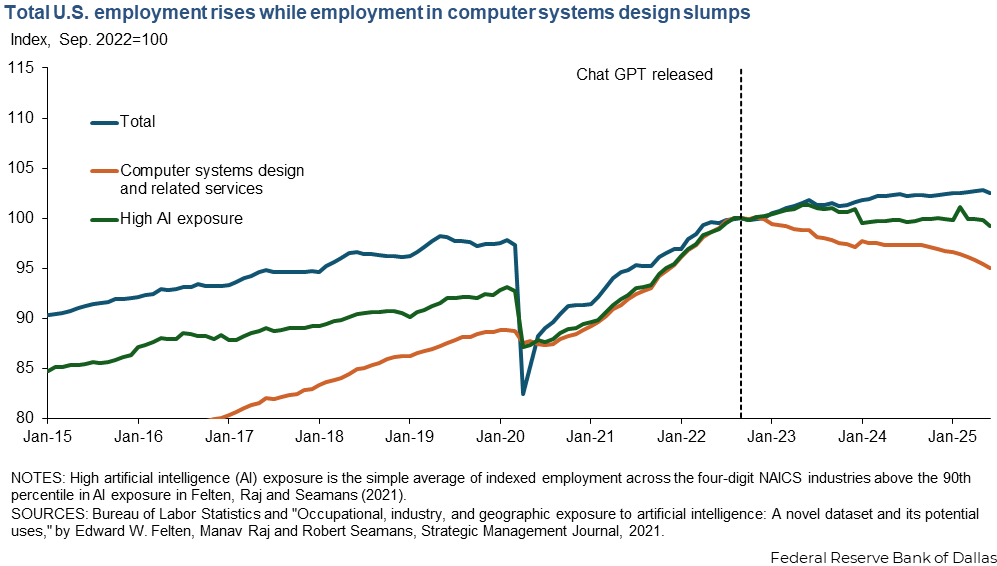
The impact of AI can be seen significantly in the tech industry, where employment for software developers between the ages of 22 and 25 fell by six percent between late 2022 and July 2025. When AI can perform most of the tasks that make up a particular job, the number of people with that job falls by about 14 percent. While the tool is helpful in some positions, for others, it reduces opportunities.
For JAIA Robotics in Bristol, Rhode Island, AI has increased its productivity. The company uses Microsoft Copilot to aid in coding speed. JAIA does not rely solely on AI for its coding. They understand how the technology works and that the user has to “massage the AI” to get the output they are looking for.
An Aquatic Drone begins its return to shore
Photo by Brenna Medeiros
Growing concerns
The application of AI in daily life requires a detailed understanding of how the tool works and what it can be used for. Each consumer has a personal responsibility to understand the technology at their fingertips.
One ethical question that surrounds AI usage is its reliability and accuracy. Many people use the software without fully understanding its purpose and what it can become. Without learning AI literacy, users of these programs are at risk of losing critical thinking skills. Using AI software with the knowledge of how it works and what purpose it serves creates a better tool for the user and a safer output.